











By ACP Oluseyi Olabisi Okuwobi
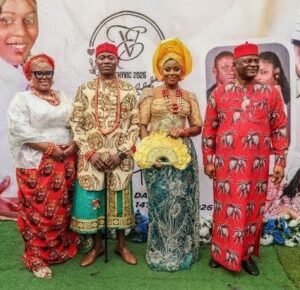 •The Inspector-General of Police, IGP Olatunji Rilwan Disu, psc(+), NPM, and his wife, Chief Mrs. Olufunmilola Mutiat Disu, flank the newlyweds, Corporal Victor Nnah Sunday and his bride, Princess Esther Kelechi Evans, during their traditional marriage ceremony in Obehie, Abia State.
How the Inspector-General of Police’s attendance at his orderly’s traditional wedding in Abia State offered a refreshing portrait of inclusive leadership and shared humanity.
Sometimes, a single photograph communicates a message that thousands of speeches cannot convey. Such was the significance of the appearance of the Inspector-General of Police, IGP Olatunji Rilwan Disu, psc(+), NPM, at the traditional marriage ceremony of his orderly, Corporal Victor Nnah Sunday, and his bride, Princess Esther Kelechi Evans, in Obehie, Abia State.
Beyond the glamour of the ceremony and the excitement that accompanied the celebration, it was the symbolism of the occasion that made it particularly remarkable. The IGP, a Yoruba man, appeared in Isi Agu, the distinctive traditional attire of the Igbo people, enthusiastically participating in the celebration of his subordinate’s marriage.
His wife, Chief Mrs Olufunmilola Mutiat Disu, National President of the Police Officers’ Wives Association (POWA), also complemented the cultural expression with her beautifully styled Igbo-inspired traditional outfit.
It was a remarkable sight: a senior police officer embracing the culture of a community different from his own, not as a ceremonial obligation but as a genuine expression of friendship, respect and solidarity.
The couple whose marriage brought everyone together were an Igbo Christian groom and his bride, while their principal and his wife belonged to a different ethnic and religious background. Yet, none of these differences mattered as they shared in the happiness of the young couple.
In that moment, tribe, religion and rank appeared to have given way to a more enduring bond — humanity.
At a time when ethnic suspicion, religious intolerance and identity politics continue to threaten Nigeria’s social cohesion, the occasion offered a refreshing reminder that national unity is not merely an idea to be promoted at political gatherings. It is a value that must be demonstrated through everyday relationships and personal conduct.
Beyond tribe: Celebrating cultural diversity
Nigeria’s cultural diversity is one of its greatest assets. With hundreds of ethnic groups, different languages, traditions and religious beliefs, the country possesses an extraordinary heritage that should strengthen its national identity.
Unfortunately, these differences have sometimes been exploited to create divisions, deepen suspicion and weaken relationships among citizens.
The IGP’s decision to wear Isi Agu at the traditional wedding offers a powerful counter-narrative to such tendencies. It demonstrates that appreciating another person’s culture does not require abandoning one’s own identity.
A Yoruba man does not become less Yoruba by wearing Igbo traditional attire. Neither does a Muslim compromise his religious convictions by celebrating the happiness of a Christian family.
Rather, such gestures demonstrate confidence, tolerance and an understanding that cultural differences should be sources of enrichment, not barriers to friendship and cooperation.
This is the spirit of a truly united Nigeria: a country where people can celebrate one another’s heritage without feeling threatened by their differences.
Beyond rank: The human side of leadership
Perhaps the most touching aspect of the occasion was the relationship between the IGP and his orderly.
The difference in their official positions is considerable. One occupies the highest office in the Nigeria Police Force, while the other is a Corporal serving as his orderly.
Yet, the difference in rank did not prevent the Inspector-General from identifying with an important personal milestone in the life of his subordinate.
The IGP could have sent a congratulatory message, delegated a representative or simply acknowledged the wedding through an official communication. Instead, he made time to attend the ceremony and personally share in the couple’s joy.
That decision speaks to an important dimension of leadership — the ability to recognise the human beings behind official designations and professional responsibilities.
An orderly is not merely an officer assigned to attend to the needs of a superior. He is somebody’s son, brother and husband, with personal dreams, family responsibilities and aspirations.
His happiness matters. His family matters. His dignity matters.
When a leader recognises and celebrates the personal milestones of a junior officer, the gesture sends a reassuring message to the wider workforce: that no individual is too junior to be seen, appreciated or treated with dignity.
This is the fatherhood dimension of leadership, where authority is complemented by compassion, consideration and genuine concern for the welfare of those under one’s supervision.
Of course, personal gestures cannot replace the institutional responsibility to provide adequate salaries, housing, healthcare, insurance and other welfare provisions for police personnel. These remain essential obligations.
However, such gestures reinforce the human values that should underpin the discharge of those responsibilities.
Rank may establish authority, but humanity earns enduring respect.
Building a police force beyond ethnic and religious divisions
The Nigeria Police Force is a national institution whose strength depends on the collective contributions of Nigerians from different ethnic, religious and cultural backgrounds.
For the institution to command public confidence and achieve its constitutional responsibilities, every officer must have a sense of belonging and equal opportunity, regardless of where they come from or what they believe.
A Christian officer and a Muslim colleague must be able to work together without prejudice. A Yoruba officer must be able to lead an Igbo colleague with fairness, just as an officer from the North should enjoy the same professional dignity and opportunities as one from the South.
Ethnicity and religion must never become measures of an officer’s worth or determinants of professional advancement.
The IGP’s appearance at the wedding is therefore a symbolic reminder of the kind of institutional culture that should be encouraged within the police — one built on fairness, inclusion, mutual respect and shared responsibility.
While one wedding cannot resolve the deep-rooted challenges of national integration or institutional welfare, it can draw attention to the values required to confront them.
A police force that reflects the diversity of Nigeria must also demonstrate that diversity through its leadership, relationships and internal culture.
My IGP, Your IGP, Our IGP!
There is a deeper meaning to the expression, “My IGP, Your IGP, Our IGP.”
“My IGP” speaks to the personal connection people develop with a leader whose actions demonstrate consideration for their humanity.
“Your IGP” recognises that the office of the Inspector-General of Police belongs to the entire nation and is not the preserve of any particular ethnic group, religious community or geographical region.
“Our IGP” reflects the collective responsibility of Nigerians to support the development of a professional, inclusive and trusted police institution.
These expressions capture the essence of leadership that transcends personal identity and embraces national responsibility.
The image of IGP Disu in Isi Agu, his wife’s complementary traditional attire and their participation in the celebration of the marriage of a Christian subordinate offer a beautiful illustration of what leadership beyond divisions can look like.
A Yoruba leader embracing Igbo culture. A Muslim couple celebrating with a Christian family. A senior officer honouring a subordinate.
Perhaps, for a moment in Obehie, Abia State, Nigerians witnessed a glimpse of the country they have long aspired to build.
The lesson is simple but profound: national unity cannot be sustained by speeches alone. It requires leaders who appreciate diversity, institutions that guarantee fairness and citizens who recognise the humanity in one another.
Nigeria needs leaders who understand that no one should be disadvantaged because of tribe, religion or rank. It needs institutions where mutual respect is not merely encouraged but reflected in everyday conduct.
Above all, it needs a renewed commitment to the shared humanity that binds its people together.
To Corporal Victor Nnah Sunday and Princess Esther Kelechi Evans, may your marriage be blessed with enduring love, peace and happiness.
To IGP Olatunji Rilwan Disu and his wife, Chief Mrs Olufunmilola Mutiat Disu, the occasion offers an opportunity to celebrate a memorable demonstration of cultural appreciation, interfaith coexistence and human-centred leadership.
The uniform may distinguish our ranks. Our religious beliefs may differ. Our cultures may be different. But our shared humanity must always unite us.
My IGP. Your IGP. Our IGP!
Beyond tribe. Beyond religion. Beyond rank. One Nigeria.