





By Festus Adedayo
“Do not take your existential burdens to Lagos/Lagosians. Lagos overburdens the burdened.” That was a last Tuesday offhanded ad-lib submission of Africa’s most cited historian, Prof Toyin Falola. He actually rendered it in its raw Yoruba form as, “E má gbê erù yín lo bá ará Èkó o; ará Èkó ńdì kún erù eni ni.”
That classic phrase warns against taking personal burdens to Lagosians. Rather than problem-solvers, Lagos, so says that phrase, is a taskmaster. It unwraps the cruel city, not as a problem-solver, nor its people as givers of succour to a troubled soul burdened by a heavy yoke. Lagos, so concluded Falola, aggravates the yoke of the already heavy-laden.
With that quip given while commencing his chairman’s remarks at an Ibadan launch of nine books authored by Lasisi Olagunju, Falola gave me what looked like a kindred corroboration of my perception of Lagos and Lagosians. Falola, Africa’s foremost historian, affirmed that my dread of everything Lagos was not misplaced. Innumerable theses have been written on this narrative of Lagos cruelty that has subsisted in history. It is an evergreen red flag from Yoruba hinterland about the people of Lagos.
Lagos circumcises the naive with its crude incisors. It is a place that thumps own chest for its bravado as the ultimate school of hard knocks. Lagos sharpens your wits dangerously than nowhere else in the world. It accommodates both sides of the divides – the thief and the lazy – as a cautionary reality check of a city that is a vast, chaotic melting pot. It is home to predators and hustlers alike, with both existing alongside each other. In Lagos, to sleep without being constantly alert could be fatal to your existence. Lagos abhors sluggishness. Its bohemian restlessness is a stern warning to the slovenly that hesitation, slowness, or gullibility have no place in the Lagos playbook.
As seemingly harmless as the Falola quip is, the phrase carries with it a historical trajectory of burdens, a recurring motif of wickedness and a timeless warning which has remained evergreen in group relations with Lagosians.
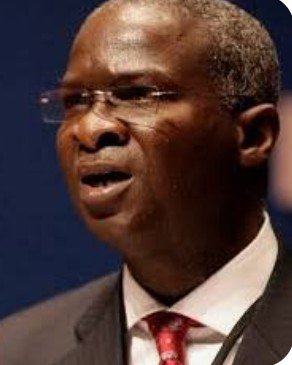
Among Nigerian politicians and administrators, the clan of Ex-Lagos State governor and ex-Minister, Babatunde Raji Fashola, is as rare as a white lion in the wild. Over decades now, both in and out of office, carefully, with stoic meticulousness, Fashola has built public reputation and perception as a distinct political brand. He is not your run-of-the-mill lazy-minded politician. He carries the image of a sober, detail-obsessed technocrat who is at home with spreadsheets than to the empty selfish rhetoric of the Nigerian politician. He is thorough in his thinking and capable of dismantling in a jiffy calculations that lack methodic rigour.
An affirmation of this came some years ago when, in company with the late Oyo State Governor Abiola Ajimobi, work trips took us to Fashola’s Marina Government House home in Lagos. Upon peeping into his parked G-Wagon vehicle, I was always gripped by wonderment. By the “Owner’s Corner” side of Fashola’s car was always a heap of books and files. I always escaped with a picture of him as a man always inebriated by books and quest for knowledge. Fashola, I concluded, epitomizes Seshat, ancient Egyptian Mistress of the House of Books. Seshat is reputed as the goddess of writing, reading, record-keeping and libraries.
That Fashola picture conflates a conservative picture of the Lagosian which has lodged for decades, rent-free, in my subconscious. Buried deep in my mind was this inexplicable dread for Lagos and Lagosians. Since about 30 years ago when I first set my legs on Lagos, time and seasons have failed to purge me of my provincial apprehension for anyone who hails from that aquatic city.
My suspicion is that the foundation of my apprehension for Lagos was laid in the late 1980s. Getting set to head for the University of Lagos as a first year student, dreadful warnings upon scary warnings about Lagos, many of them unsolicited, were generously donated to me. Lagos, I was told, was a merciless city that takes no prisoners; Lagos takes all and gives seldom. Its ferocious reputation as city with a malignant passion for castrating manhood and making the impotent suffer resonates in my mind like a musical rhetoric. So, as I headed for Lagos, I stuffed my school fees inside my tight sucks, refusing to talk to anyone. I was told that even a mere greeting a Lagosian could throw you by the sidewalks crying over your mysteriously filched hard-earned money.
Corpus of street expressions that carry stark, intimidating warnings emphasize Lagos’ unforgiving spirit. Those scary rhetoric of Lagos’ constant hustle and street-smart survival tactics point at the city’s Mafia pride and its place as a city where naivety is fatal to ambitions. Lagos rarely allows you relive your fatal mistake twice.
Then came Fashola – my Seshat idol – appearing in an interview session on Arise TV last week. Over the last few weeks, he has staked his hard-earned reputation on marketing the current APC administration. Each time he does so, what comes to my mind is a reflection on an earlier engagement in which he mounted a spirited defence of the federal government’s petrol cost infamy. His argument was that the Tinubu administration’s removal of petrol subsidy was a World Bank decision.
That claim instantly recalled the dependency theories propounded by scholars like the Egyptian Samir Amin and the Guyanese Walter Rodney. These scholars were against Fashola and those who sent him on errand. They argued that the global financial system, including the World Bank and the IMF, keeps African nations trapped in poverty. For Fashola to latch onto such an argument as a defence for Tinubu was more than distressing.
Looking at the general thrust of his arguments for the government over the last two weeks, my mind flicked to Fashola’s famous words in October 2015 during his Senate ministerial screening. Fashola had told the parliament, “May our loyalty never be tested.” It was a remark widely interpreted at the time as a reflection of the hippopotamus-sized pressure he faced not to accept an appointment from Muhammadu Buhari, who had by then begun to bare his presidential fangs at Bola Tinubu, the very man who helped him into Aso Rock.
A miasma of thoughts crowded my mind, chief among which was a rhetorical question: Is Fashola’s sudden, uncoordinated waffle an attempt to deflect Tinubu’s self-inflicted poisoned chalice; a deep reflection of a troubling presidential frown over the Pontius Pilate aloofness Fashola had shown toward the Tinubu government for nearly four years?
This explains why his television appearance came across as so jarring. One could almost pity him as my admired Fashola waffled through illogical answers, trading the rigour for which he had carved an admirable renown for the selective memory of a campaign surrogate. Save for his signature cap, one could easily mistake him for the superficial commune of esophagus canvassers like Daniel Bwala, Femi Fani-Kayode, Reno Omokri, or even our ègbòn, the highly reversible Bayo Onanuga.
That Fashola TV engagement was an hour of polished deflection that lacked grit; what my symbolic logic teacher, Prof. C. S. Momoh, would call an assault on the coherence of logic and knowledge. Fashola’s intervention can be summed up as an invitation to Nigerians to view the Tinubu administration’s record through a lens of political convenience. His defence relied heavily on false equivalences, most notably his equation of disappearing fuel queues with relief from the excruciating cost-of-living crisis.
Fashola’s take on the bothersome questions surrounding the president’s academic records was the most distressing of all. He dismissed them as distractions that do not affect the price of bread, noting that Tinubu has always emerged victorious in elections. At that point, I was almost convinced that the interviewer, Ojy Okpe, had brought to her show a doppelganger – a carefully curated body double of my adored Babatunde Fashola.
Wait for this: In response to former British Prime Minister David Cameron’s May 2016 description of Nigeria, alongside Afghanistan, as “fantastically corrupt,” Fashola deflected domestic accountability by arguing that Western critics live in glass houses because they are “fantastically good at keeping stolen monies.” At that point, I did the twin of shuddering and murmuring the phrase, “And Jesus wept,” for which our late professor friend, Pius Adesanmi, holds the patent.
Beneath Fashola’s calm, legalistic cadence in justifying Nigerian existential tragedies lies a troubling series of false equivalences: he mistook the absence of fuel queues for economic relief. That same gruelling, unprecedented cost of purchasing petrol was a similar economic pestilence which, among other factors, cost Donald Trump a midterm election victory in the US.
Of all his arguments in that interview, nowhere was Fashola’s disconnect from the burden of ordinary Nigerians clearer than in his unfeeling celebration of disappearing fuel queues. He betrayed an utter aloofness from the visceral hardship Nigerians endure, exposing the chasm he dug between technocratic framing and everyday economic reality. To be sure, no one can dismiss the fact that, against our national norm of over 20 years now, especially as the yuletide season approaches, motorists under Tinubu have largely forgotten the malaise of spending days sleeping in queues at filling stations.
However, celebrating an empty forecourts without acknowledging why they are empty is akin to boasting of an empty hospital waiting room after imposing excruciating consultation fees on same patients. Today, petrol has been priced out of the reach of ordinary artisans, commuters and small businesses, with this naturally contracting demands for it.
The Fashola polemicist Nigerians once knew would have argued that petrol queues do not vanish because of prosperity, but that they collapse at the feet of dwindling purchasing power. Instead, Fashola pointed to smooth-flowing petrol stations as a rebuttal of the plight of millions of households who today ration foods, transport and electricity under harsh government policies. What he simply did was to confuse supply mechanics with human welfare.
Equally troubling was Fashola’s dismissal of renewed scrutiny over President Tinubu’s certificates and personal history. To me, this is the politics of wayfarers. His argument rested on two claims: first, that certificate controversies do not reduce the cost of living; and second, that because Tinubu has faced these questions since the 2000s and “always wins,” litigation and public interrogation should simply cease. That reasoning is wholly un-Fashola. It displays a remarkably casual attitude toward the institutional standards of constitutional democracy, where transparency, especially requested from holders of the highest office in the land, is not an academic parlour game to be traded off on television interview.
Transparency is the bedrock of public trust and the rule of law. If Nigerians ask for it a million times, it is deserving. Whether state institutions apply rules evenly or bend them for powerful incumbents directly shapes the confidence of markets, investors, and citizens alike. More fundamentally, while electoral victory confers a mandate, it does not retroactively seal public records or place an expiration date on democratic scrutiny. Consider the examples of Salisu Buhari and Evan(s) Enwerem in the then nascent Fourth Republic. Both disgraced parliamentarians show that winning elections does not erase questions regarding integrity, because democracy does not suspend courts, legislatures, or a free press between ballot boxes.
Fashola’s third line of defence was as hollow as a tombstone. Here, he simply conflated Tinubu’s elite political patronage with national inclusion, and peremptorily substituted electoral survival for public accountability. For allegations of Tinubu’s politics of cronyism, he opened a trough of narratives of loyal former aides for Nigerians to gulp from. His comparison of Tinubu, Atiku Abubakar, and Peter Obi as former governors, and his assertion that Tinubu’s enduring circle of former associates proves his mastery of Nigeria’s diversity, rang hollow. The truth is that Tinubu’s journey from Alausa to Aso Rock is lined with a crown of thorns made of prominent political ruptures, from estranged ex-governor associates to sidelined loyalists whose fallout with him played out in full public view.
For every Raji Fashola, there are dozens Tokunbo Afikuyomis, Bucknor-Akereles, Akinwunmi Ambodes, and Rauf Aregbesolas. More tellingly, assembling a resilient coalition of political actors to retain power reflects transactional statecraft, not the equitable governance of an extraordinarily diverse nation. Retaining political allies is a mirror of patronage and political survival, not mastery of national inclusion. One would have expected Fashola to reel out data demonstrating Aso Rock’s commitment to fair representation, shared prosperity, and social cohesion across regions and classes.
Indeed, some scholars, examining how Tinubu has kept Lagos tied to his apron strings for the past 26 years, see something far more troubling than leadership acumen: a power chemistry forged in temples of oath, coercion, patronage, and ironclad loyalty masquerading as grassroots fidelity.
Fashola’s remaining pivots were equally embarrassing. A Fashola unencumbered by political pressure would acknowledge that governments rarely lose public trust merely because they face difficult economic headwinds, as the Tinubu administration has over nearly four years. Nigerians know that governance is not mọiǹ-mọiǹ, as street lingo puts it. Citizens understand that administering over 200 million people entails immense challenges and that complex reforms take time. People begin to lose trust, however, when venerated voices like Fashola ask them to ignore the emptiness of their pockets and the leadership deficit confronting them at every turn.
What Fashola effectively did was urge Nigerians to abandon questions of transparency at the Villa and accept political survival as the ultimate metric of leadership. Across his two media interventions in recent days, Fashola delivered a suave performance in defence of a troubled government, yet failed entirely to offer convincing answers to citizens living with the consequences of government’s uncritically taken policy choices.
Fashola needs to be reminded that Nigerians do not measure governance by how suavely a former governor and minister wins a television debate, nor by how many politicians remain loyal to the president. Just as Prof Falola warned at the outset, a nation already heavy-laden with existential burdens needs genuine problem-solvers, not Lagos taskmasters who overburden the burdened and tell the suffering people to embrace the cruelty of the hustle. The true measure of leadership is whether public institutions command trust and ordinary lives improve. A thousand-and–one of Fashola’s attempts to make a corpse walk will not suade Nigerians.
The former governor also confidently stated in that Ojy Okpe interview that APC would not allow Peter Obi do what he did in Lagos in 2023 by winning the 2027 elections. I think it is not about what the APC will do but what Lagosians will. Nigerians and Lagosians will decide the 2027 elections, not by how well Aso Rock plays the ruthless Lagos game of political survival, but by whether, after four years, the people’s hopes were genuinely renewed, or whether they were served yet another cycle of empty, recycled promises.
•Published by the Sunday Tribune.