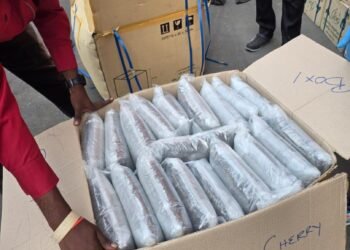
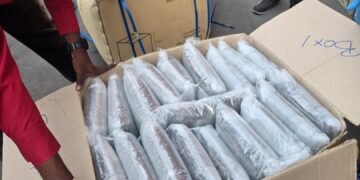

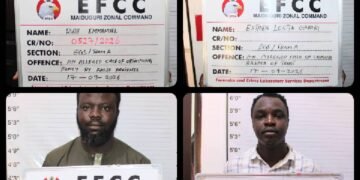









The United States has raised concerns over the growing activities of Mexican drug cartels in Africa, warning that Nigeria could become a major manufacturing hub for methamphetamine following the discovery of four clandestine laboratories linked to the networks.
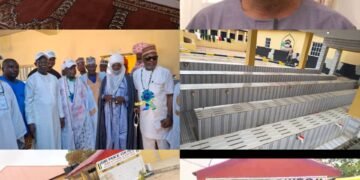
The US Deputy Assistant Secretary of State for International Narcotics and Law Enforcement Affairs for Africa and the Middle East, Michael Gonzales, gave the warning on Tuesday during a visit to the headquarters of the National Drug Law Enforcement Agency in Abuja.
Gonzales commended the NDLEA for dismantling four methamphetamine laboratories this year, describing the operations as evidence of intelligence-led investigations, inter-agency cooperation and effective law enforcement.
He said Nigeria was his first destination after assuming office four months ago because of its strategic importance and the agency’s achievements in combating drug trafficking.
“The four meth lab busts just this year alone are a testament to the deployment of some of the best practices in our tradecraft,” he said.
Gonzales warned that increased pressure on drug cartels in the Western Hemisphere could push criminal networks to seek alternative trafficking routes through Africa to reach markets in Europe and other regions.
He also highlighted the growing threat posed by synthetic drugs, which he said were more difficult to detect and potentially more dangerous, stressing the need for countries to strengthen cooperation against transnational criminal organisations and their financial networks.
In his response, the NDLEA Chairman, Brig. Gen. Mohamed Buba Marwa (retd.), said the agency’s recent operations had exposed what he described as a deliberate attempt by Mexican cartels to establish Nigeria as a methamphetamine production base.
Marwa said operatives recently dismantled what the agency described as Nigeria’s largest clandestine methamphetamine laboratory in a forest in Ijebu East Local Government Area of Ogun State.
He said three Mexican nationals identified as methamphetamine experts and their Nigerian collaborators were arrested during the operation, while illicit substances valued at more than $360m were recovered.
According to him, the agency subsequently raided another industrial-scale laboratory in Tapa village, Oyo State, arresting a Mexican methamphetamine expert and four Nigerian collaborators.
He added that similar facilities had been dismantled in Enugu and Ebonyi states.
“These were not isolated incidents. They show a deliberate attempt to turn Nigeria into a manufacturing hub,” Marwa said.
The NDLEA chairman said the cartels were not targeting only the Nigerian market but were seeking to use West Africa as a corridor for transporting large quantities of methamphetamine to Europe, Asia and the United States.
He argued that intensified enforcement against cartels in the Americas was encouraging traffickers to explore alternative routes to reach international markets.
“Every meth-producing laboratory that we shut down is a supply line that never reaches an American street, and every cartel operative we arrest is one fewer in the pipeline,” Marwa said.
He added that the agency’s forensic experts, investigators and tactical teams were helping protect communities in both Nigeria and the United States.
Marwa also warned that drug trafficking, arms smuggling and terrorism financing were increasingly interconnected, noting that proceeds from illicit drug sales could fund weapons and sustain armed groups operating in the Sahel and Lake Chad Basin.
He said cooperation with the United States had strengthened the NDLEA’s capacity in forensic and chemical analysis, professional training, investigations, financial-crime detection and equipment maintenance.
According to him, the agency arrested 96,157 drug offenders, including 250 drug barons, seized more than 15.8 million kilogrammes of assorted illicit drugs and secured the conviction of 16,691 traffickers over the past five years.
Marwa urged the US government to sustain or increase its assistance to Nigeria, warning that any reduction in support could create gaps exploited by criminal and terrorist networks.
He stressed that international cooperation remained essential because traffickers, arms dealers and terrorist groups operated across national borders.
“Traffickers, arms dealers and terrorists cooperate across borders every day, and governments confronting them must do the same,” he said.